
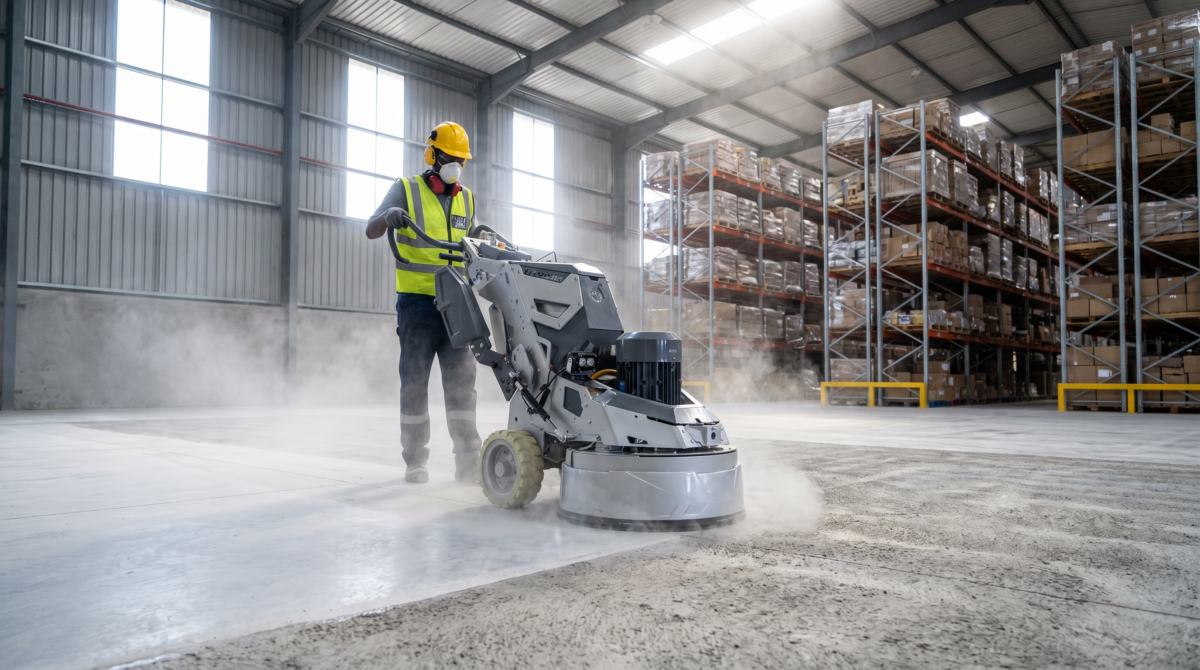
A warehouse floor is one of the hardest-working surfaces in any business. It carries forklift traffic, pallet jacks, racking loads and constant foot traffic, day in and day out. Whether you are applying a high-build epoxy, a polyurethane screed, a densified polished finish or a simple sealer, one truth holds across all of them: the coating or finish is only as good as the surface preparation underneath it.
Skip the prep, or do it badly, and you will see the consequences within months — delamination, blistering, bubbling, dusting and premature wear. Get it right, and you have a floor that lasts for decades. This guide walks through why surface preparation matters, the main methods used on warehouse slabs in South Africa, and how to choose the right grinding equipment for the job.
Why Surface Preparation Matters
New and existing concrete slabs are rarely ready to receive a coating straight off the trowel. The surface is typically sealed by laitance — a weak, dusty layer of fine cement particles that rises to the top during finishing. On top of that you often find curing compounds, old coatings, glues, oil contamination and surface irregularities.
Surface preparation does three critical things:
- Removes weak and contaminated layers so the new system bonds to sound, structural concrete rather than to laitance or old residue.
- Creates a mechanical profile — a controlled roughness, or “tooth,” that the coating can grip. This is measured using the CSP (Concrete Surface Profile) scale.
- Levels and flattens the slab, removing trowel marks, high spots and trip hazards so the finished floor is even and safe for traffic.
Understanding CSP Profiles
The International Concrete Repair Institute (ICRI) defines surface profiles on a CSP scale from CSP 1 (nearly smooth) to CSP 9 (very rough). The profile you need depends on the system you are applying:
| Coating / Finish | Typical Profile | Recommended Method |
|---|---|---|
| Thin sealers, densifiers, polished concrete | CSP 1–2 | Diamond grinding |
| Thin-film epoxy & polyurethane (< 0.5 mm) | CSP 2–3 | Diamond grinding |
| Self-levelling epoxy (0.5–3 mm) | CSP 3–4 | Grinding or light shot blasting |
| High-build & broadcast systems (3–6 mm) | CSP 4–5 | Shot blasting / scarifying |
| Heavy-duty screeds & mortars (> 6 mm) | CSP 5–9 | Scarifying / scabbling |
The rule of thumb: the thicker the coating, the more aggressive the profile. A common and costly mistake is applying a thick system over a smooth, ground-only surface, or applying a thin coating over an aggressively blasted one.
The Main Surface Preparation Methods
Diamond Grinding
Diamond grinding is the most versatile and widely used method for warehouse floors. Rotating diamond-segment tooling cuts the surface to remove laitance, coatings and irregularities while producing a consistent, repeatable profile. It is the go-to choice for polished concrete, thin coatings and general flattening.
Modern planetary grinders drive multiple grinding heads that counter-rotate beneath a main plate. This delivers a flatter, more uniform finish and far higher productivity than older single-disc machines — essential when you are covering thousands of square metres of warehouse slab.
Shot Blasting
Shot blasting fires steel shot at the surface at high speed, abrading the concrete and immediately recovering the shot and debris in an enclosed, near-dustless system. It is ideal for fast, aggressive profiling over large open areas and for preparing slabs ahead of thicker build coatings.
Scarifying & Scabbling
For the most aggressive removal — thick coatings, heavy contamination or significant level correction — scarifiers and scabblers use rotating cutters or pistons to fracture and remove the surface. These leave a coarse profile suited to heavy-duty screeds and repair mortars.
Choosing the Right Grinder for Your Warehouse
The right machine depends on the area, the slab condition and the finish you are targeting. Diamond Products Group, South Africa’s diamond tool specialist since 1998, carries a full range of floor grinding machines to match the job:
- DP 300mm Single Head Floor Grinder (Qwickchange/Qwik-Lok) — A nimble single-head machine with a quick-change tooling system, ideal for smaller areas, edge work, spot repairs and contractors starting out in concrete prep.
- DP 300V Single Head Floor Grinder — A robust single-head unit for general-purpose grinding, coating removal and surface prep on small to medium floors.
- DP 480 Triple Head Grinder — A productive triple-head machine that delivers a flatter finish and faster coverage, well suited to medium warehouse bays and busy prep crews.
- Lavina L16EU Triple Head Grinder — A compact planetary grinder offering professional polishing and prep quality, easy to manoeuvre around racking and obstacles.
- Lavina L20S7 Triple Head Grinder — A higher-capacity planetary machine built for larger floor areas and demanding polishing and preparation work.
- Lavina L25S7 & L25RS7 (Remote-Controlled) 25″ Grinders — Wide-format planetary grinders for high-volume warehouse and industrial slabs. The remote-controlled L25RS7 reduces operator fatigue and boosts productivity over very large areas.
For dense slabs, also consider a walk-behind power trowel during the placement and finishing stage to produce a hard, consistent surface that grinds and polishes predictably later on.
A Practical Prep Workflow
- Assess the slab — Check moisture, hardness, contamination and existing coatings. A moisture test is essential before any coating goes down.
- Remove coatings and laitance — Use the appropriate aggressive metal-bond diamond tooling or shot blasting to get back to sound concrete.
- Flatten and refine — Grind out high spots and trowel marks; step through progressively finer tooling to reach the target CSP profile.
- Manage the dust — Always pair grinders with an industrial dust extractor for a safe, compliant, near-dustless site.
- Clean thoroughly — Vacuum the surface completely so no dust interferes with the bond.
- Test and apply — Confirm the profile and moisture levels, then apply the coating system per the manufacturer’s specification.
Caring for the Floor After It’s Finished
Surface preparation gets the floor down — but a warehouse slab only stays bright, dense and durable if it’s maintained properly. Polished and coated concrete is low-maintenance, not no-maintenance. The right routine keeps the gloss up, protects the investment and pushes out the next costly re-grind by years.
Lock in Density and Stain Resistance with a Densifier and Sealer
Before and after final polishing, a lithium or silicate densifier chemically hardens the slab, reduces dusting and improves abrasion resistance. Diamond Products Group supplies a Densifier (20 lt) for exactly this stage. A penetrating FloorPro Hydrobuff Sealer then adds stain and liquid resistance without leaving a sacrificial topical film that can wear unevenly under forklift traffic — ideal for busy warehouse environments.
For grout and fill work during prep and repair, Grind n Grout and the wider floor chemicals range round out the system.
Keep It Clean — Daily and Periodically
Most warehouse floor wear is actually abrasion from trapped grit. Dust, sand and debris ground underfoot and under wheels act like sandpaper, dulling the polish over time. A simple cleaning routine prevents this:
- Daily: Dust-mop or sweep to lift loose grit, and address spills promptly.
- Weekly / as needed: Wet-clean with an auto scrubber using a pH-neutral cleaner. Avoid acidic or harsh degreasers, which etch and dull polished concrete.
Diamond Products Group’s scrubbing range suits everything from small bays to full distribution centres:
- 425 Floor Scrubber (with pad, brush & tank) and the Viper DS350 dual-speed Polisher/Scrubber for compact and mid-sized areas.
- Walk-Behind Floor Scrubbing Machine (220V) and the AS4335C Auto Scrubber for larger, high-traffic warehouse floors.
Pair these with Stripping / Cleaning / Buffing Pads matched to the task — strip pads for deep cleaning, buffing pads for routine maintenance.
Restore and Maintain the Gloss
Over time, traffic flattens the shine. Rather than re-grinding, the gloss can be revived periodically:
- Burnishing with a high-speed machine such as the DR1500H Burnisher or the Eagle 700mm Propane Burnisher heats and re-hardens the surface, bringing back a deep, reflective finish over large areas quickly.
- For deeper refresh or maintenance polishing, Suprashine Pads, Resin Polishing Pucks and Ceramic Polishing Pucks (fitted with Velcro Plates) step the surface back up through the grits without a full re-prep.
Measure, Don’t Guess
Professional floor care is verified, not assumed. The right instruments take the guesswork out of both prep and ongoing maintenance:
- Pro Concrete Moisture Meter — confirm the slab is dry enough before sealing or coating.
- Concrete Hardness Tester — gauge slab hardness to select the correct diamond tooling and densifier approach.
- Gloss Meter — track the floor’s gloss level over time so you burnish or re-polish before the finish visibly degrades.
A practical maintenance cycle looks like this: daily dust control → weekly auto-scrub → periodic burnish → annual gloss check and re-densify/seal as needed.
The Bottom Line
Warehouse floors are a long-term investment, and surface preparation is where that investment is won or lost. Match your CSP profile to your coating, choose a grinding machine sized to your floor area, control the dust, and never coat over a contaminated or under-prepared slab.
Diamond Products Group has equipped South African contractors with diamond tooling and floor grinding machines since 1998. From the compact DP 300 single-head grinders to the remote-controlled Lavina L25RS7, we can match the right equipment and tooling to your warehouse project.
Get in touch with Diamond Products Group: 📞 0861 7575 75 | ✉️
Explore the full floor prep, polishing and care range:

